

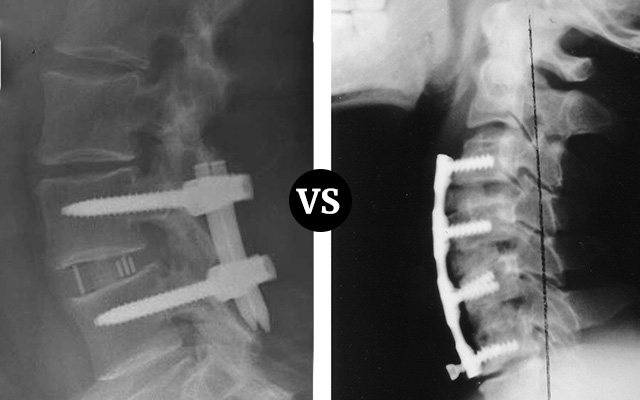
Back pain has a way of taking over your life quietly at first. It may begin as a small stiffness after long sitting, then slowly turn into pain while walking, bending, sleeping, or even standing for a few minutes. And when medicines, physiotherapy, injections, and lifestyle changes stop giving enough relief, spine surgery may come into the discussion.
One option doctors may suggest in selected cases is lumbar fusion surgery. But here is where many patients get confused. Is one spinal level being fused enough? Or does the problem involve more than one level?
The answer matters because single-level and multi-level fusion can have very different recovery timelines, movement changes, risks, and long-term outcomes.
If you are considering lumbar fusion surgery in London, consulting Dr Purnajyoti Banerjee can help you understand whether your spine needs a focused one-level correction or a more complex multi-level approach.
What Is Lumbar Fusion Surgery?
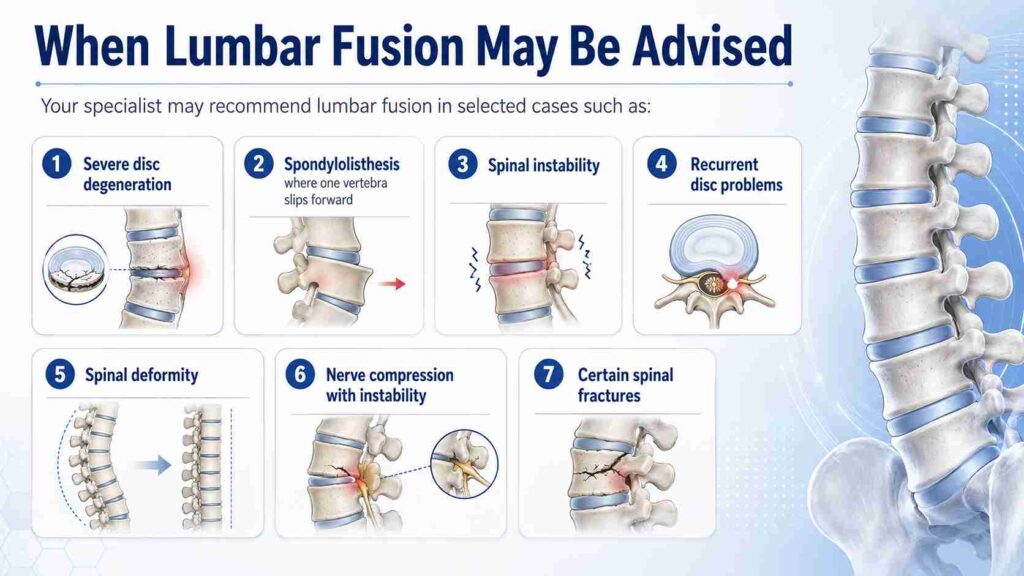
Lumbar fusion is a spine surgery where two or more bones in the lower back are joined together so they heal into one solid bone. The main goal is to stop painful movement at an unstable or damaged spinal segment.
What Is Single-Level Fusion?
Single-level fusion means only one spinal motion segment is fused. This is usually considered when the problem is clearly limited to one level of the lumbar spine.
Let’s say only one disc has worn out. Or one vertebra has slipped. Or one spinal level is pressing on a nerve and causing leg pain. In such cases, the surgeon may focus only on that specific level.
Single-level fusion may be suitable when:
- One level is clearly unstable
- One disc is severely damaged
- One nerve is compressed at a specific point
- Symptoms match the MRI findings
- Other spinal levels are still reasonably healthy
The biggest advantage of single-level fusion is that it is more focused. The surgeon is treating one main pain-generating area instead of operating across a larger section of the spine.
Possible benefits of single-level fusion include:
- Less surgical complexity
- More spinal movement preserved
- Comparatively easier recovery
- Less stress on the body
- Lower chance of stiffness compared with longer fusions
That said, it is still spine surgery. It needs proper planning, careful aftercare, and realistic expectations.
What Is Multi-Level Fusion?
Multi-level fusion means two or more spinal levels are fused.
Multi-level fusion may be advised for:
- Multi-level disc degeneration
- Degenerative scoliosis
- Severe spinal instability
- Multi-level nerve compression
- Spinal deformity
- Poor spinal alignment
- Complex revision cases
The goal may be to:
- Improve spinal alignment
- Reduce nerve compression
- Stabilise multiple weak levels
- Reduce deformity-related pain
- Improve walking ability
- Support long-term spinal balance
However, multi-level fusion is usually more complex because more of the spine is involved. It may mean longer surgery, longer recovery, more stiffness, and a greater need for structured rehabilitation.
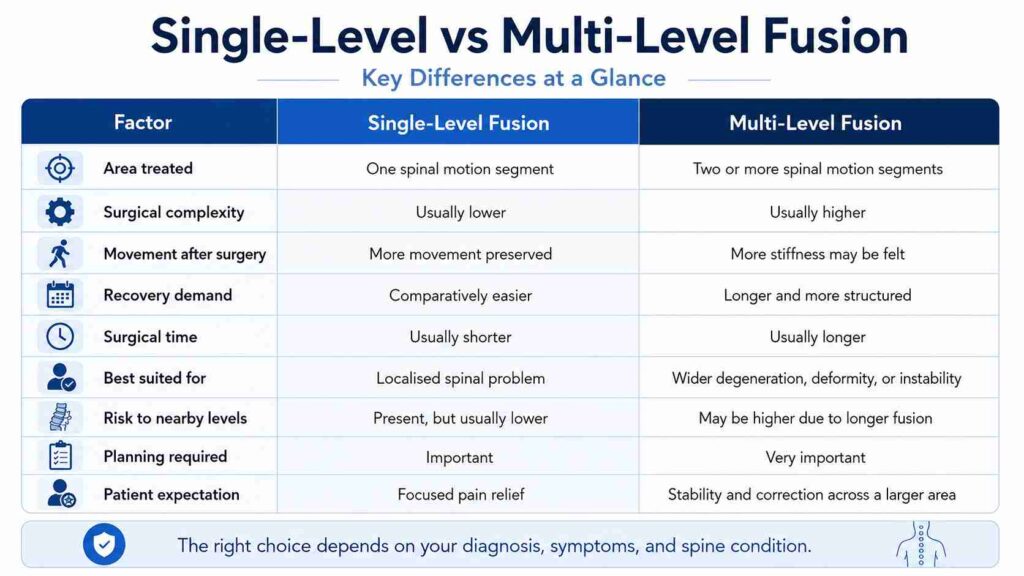
Single-Level vs Multi-Level Fusion: Quick Comparison
How Do Pain Outcomes Differ?
The success of lumbar fusion depends on whether the actual pain source has been correctly identified. A scan may show several worn-out discs, but not every worn-out disc causes pain. This is why symptoms, physical examination, and imaging must all match.
Pain outcome after single-level fusion
Single-level fusion may give more predictable pain relief when the problem is clearly limited to one level.
Patients may benefit because:
- The surgery is more targeted
- Less of the spine is disturbed
- More natural movement is preserved
- Recovery may be comparatively smoother
Pain outcome after multi-level fusion
Multi-level fusion can also improve pain, especially when several levels are genuinely causing symptoms.
However, the outcome may be less predictable because:
- More spinal levels are involved
- More muscles and tissues are affected
- Recovery takes longer
- The spine loses more movement
- Other health factors play a bigger role
How Does Movement Differ After Surgery?
Your lower back helps you bend, twist, sit, stand, walk, and balance your posture. When a spinal level is fused, movement at that level is reduced.
So naturally, the more levels fused, the more movement may be affected.
After single-level fusion
Most patients still retain a reasonable amount of lower-back movement because only one segment is fused.
Daily activities may become easier after recovery, such as:
- Walking
- Sitting
- Standing
- Climbing stairs
- Light household work
- Desk-based work
The nearby spinal levels continue to move, so stiffness is often less noticeable than in longer fusions.
After multi-level fusion
Movement restriction may be more noticeable after multi-level fusion.
Patients may need to be more careful while:
- Bending forward
- Getting out of bed
- Wearing shoes
- Lifting bags
- Sitting for long hours
- Getting in and out of a car
This does not mean patients cannot return to normal life. It simply means they may need to learn smarter movement habits.
Good physiotherapy can help patients move safely, protect the spine, and rebuild confidence.
How Does Recovery Differ?
Recovery after lumbar fusion depends on the type of surgery, the number of levels fused, the patient’s general health, and how well rehabilitation is followed.
Recovery after single-level fusion
Single-level fusion often has a more manageable recovery journey.
Patients may gradually return to:
- Short walks
- Light daily activities
- Desk work
- Gentle exercises
- Supervised physiotherapy
- Normal routine with restrictions
Because only one level is fused, the body may adapt faster.
Still, healing takes time. Bone fusion does not happen overnight. It is a biological process, not instant glue.
Recovery after multi-level fusion
Multi-level fusion usually needs more patience.
Recovery may involve:
- Longer hospital stay
- More post-operative soreness
- Slower return to work
- More movement restrictions
- A longer physiotherapy plan
- More focus on posture and walking
Patients may also need extra support at home in the early weeks, especially for daily activities like bathing, dressing, cooking, and climbing stairs.
Making the Right Choice
Single-level and multi-level fusion both aim to reduce pain, improve stability, and help patients move better. But the outcomes can differ in important ways.
If you are planning lumbar fusion surgery in London, consulting Dr Purnajyoti Banerjee can help you understand whether a single-level or multi-level approach may offer the best balance.
Book an appointment today at this email address: purnajyoti74@gmail.com.
People Also Ask
1. How do doctors decide between single-level and multi-level lumbar fusion?
Doctors decide based on MRI findings, symptoms, spinal stability, nerve compression, and how many spinal levels are affected. If only one level is causing the problem, single-level fusion may be enough; if several levels are unstable, multi-level fusion may be considered.
2. Is multi-level spinal fusion riskier than single-level fusion?
Multi-level fusion is usually more complex because more spinal segments are treated. It may involve a longer recovery, more stiffness, and a higher chance of stress on nearby spinal levels.
3. How long does it take to recover from lumbar fusion surgery?
Recovery varies from person to person, but many patients need several weeks to return to light activities. Complete healing and spinal fusion may take several months, depending on age, health, and the number of levels fused.
4. Can you live a normal life after lumbar fusion surgery?
Yes, many patients return to daily activities after proper healing and rehabilitation. However, they may need to avoid heavy lifting, sudden twisting, or poor posture habits to protect the spine.
5. When is lumbar fusion surgery recommended for back pain?
Lumbar fusion may be recommended when back pain is linked to spinal instability, severe disc degeneration, deformity, or nerve compression. It is usually considered when non-surgical treatments have not provided enough relief.